
VII EDITION
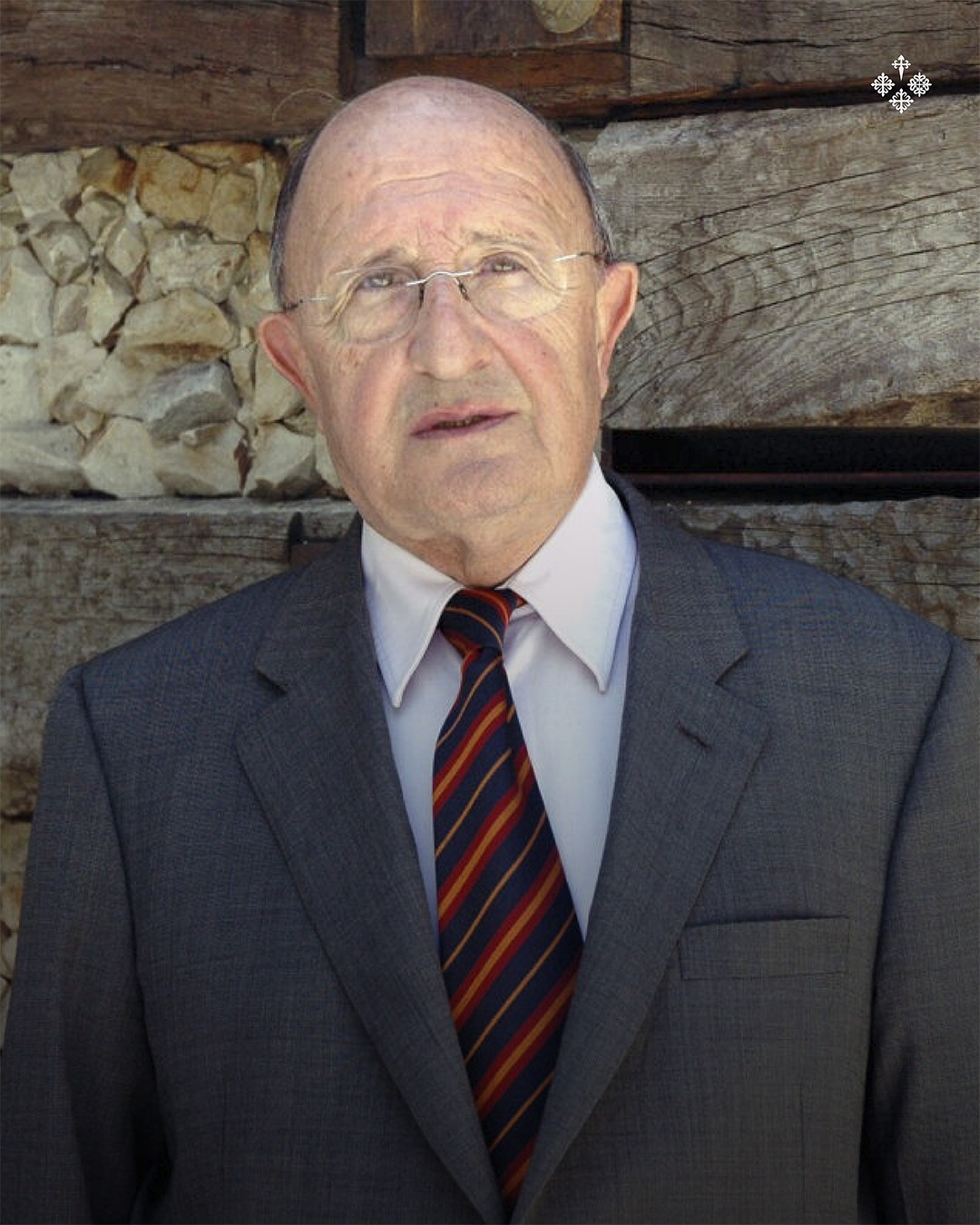
The jury of the International History of the Spanish Orders Award announced, during the ship Juan Sebastián Elcano’s stopover in New York on 10 June, that José Antonio Escudero was the winner of its 7th edition. The laureate has been honoured for his distinguished career as a historian and jurist, with significant international recognition in the fields of law, political and administrative institutions, and the Inquisition in Europe.
The news was announced by HRH Don Pedro de Borbón Dos Sicilias y de Orleans, chairman of the Prize’s jury, at the well-attended event ‘Spanish Contribution to the American Revolution’, held thanks to the collaboration of the Spanish Navy and organised by the Fundación Órdenes Españolas and the Queen Sofía Spanish Institute, as part of the America&Spain250 initiative, which aims to celebrate, through a series of activities, 250 years of shared friendship between the United States, Spain and the Spanish-speaking world.
The winner’s nomination was put forward by Carmen Iglesias, director of the Royal Academy of History, and the Governing Council of the University of San Pablo-CEU, of which José Antonio Escudero has been an honorary doctorate holder since 2010.
The award winner (born in Barbastro in 1936) is one of the most distinguished legal historians, internationally recognised for his pioneering and innovative contributions. Over the course of more than six decades of academic work, he has taught at prestigious Spanish universities (in recent years at the Complutense University and the UNED), whilst also conducting research at other institutions across Europe: the London School of Economics and Political Science in London; the Universities of Bonn and Göttingen in Germany; and the Universities of Vienna and Stockholm, amongst others. For one year, he was a visiting professor at universities in the United States (Madison, Berkeley and Stanford) as part of a Ford Foundation programme, conducting research in archives and libraries around the world. He is a full member of the Royal Academy of History and the Royal Academy of Jurisprudence and Legislation of Spain; he previously served as president of the latter and currently holds the title of Honorary President.
His research, always erudite and often presenting critical and innovative arguments, has opened up new perspectives on the governmental and administrative institutions of modern Spain, with seminal works such as *The Secretaries of State and of the Cabinet*, *The Origins of the Council of Ministers*, *Philip II: The King in the Cabinet*, *Administration and the State in Modern Spain*, and *The Memorial of the Count of Aranda*, etc., all of which are regarded as indispensable references. His textbook *Curso de Historia del Derecho* has been instrumental in the legal education of thousands of students in Spain and abroad. He has also edited major collective works, such as *El Rey. Historia de la Monarquía*; *Cortes y Constitución de Cádiz*; *Los Validos*; and *Perfiles Jurídicos de la Inquisición española. *The Church in the History of Spain*, and has received special recognition for his pioneering work and studies on the Spanish Inquisition, within the framework of which he founded and directed the Institute of the History of Intolerance.
His work has been recognised with various awards and honours. These include the Riaza Prize from the Complutense University, the Menéndez Pelayo Prize from the CSIC, and three National History Prizes in 1969, 1979 and 2009. He was recently awarded the Pintó Prize, “ ‘A Life Dedicated to Law’, from the Spanish Bar Associations. He has also been awarded several honorary doctorates from Spanish and foreign universities, as well as high honours at both national level (the Order of Constitutional Merit and the Grand Crosses of the Order of Alfonso X the Wise and of Saint Raymond of Peñafort) and regional level (the Aragón Prize). In the field of academia, it is worth noting that he founded and directed the first courses at the Complutense University in El Escorial, and that he served as an ex officio member of the Council of State and as president of the Institute of Spain.
In the Americas, Dr Escudero is an Honorary Professor at the National University of San Marcos (Peru), the University of Tlaxcala (Mexico), the Nicaraguan Academy of Jurisprudence, and others. He has been awarded the Gold Medal of the University of Córdoba (Argentina) and the Medals of Honour from the Autonomous University of Monterrey (Mexico) and the Lima Bar Association.
Beyond the academic sphere, he played a significant role in the consolidation of democracy in Spain. He served as a Senator and Chair of the Senate’s Committee on Education and Culture, as well as a member of the Constitutional Committee during the drafting of the 1978 Constitution. He was also chairman of the RTVE Board, director-general of the Spanish Institute for Emigration and, for twelve years (1987–1999), a Member of the European Parliament.
The aim of this award, which has increased its prize money this year to €65,000, is to recognise the history and career of those researchers who have worked with dedication and rigour to convey the truth of past events, provided that some aspect of their work relates to Hispanic culture and its global influence.
The prize is administered by the Fundación Órdenes Españolas and is supported by: the Fundación Areces; the Fundación Talgo; the Real Asociación de Hidalgos de España; the Fundación Nemesio Diez; Mr Ramón Pérez-Maura, in a personal capacity; and through the Historiae Amicus association, managed by the Fundación Órdenes Españolas and comprising various individuals acting in a personal capacity. This enables the Award to enjoy an ever-greater presence and recognition in today’s society.